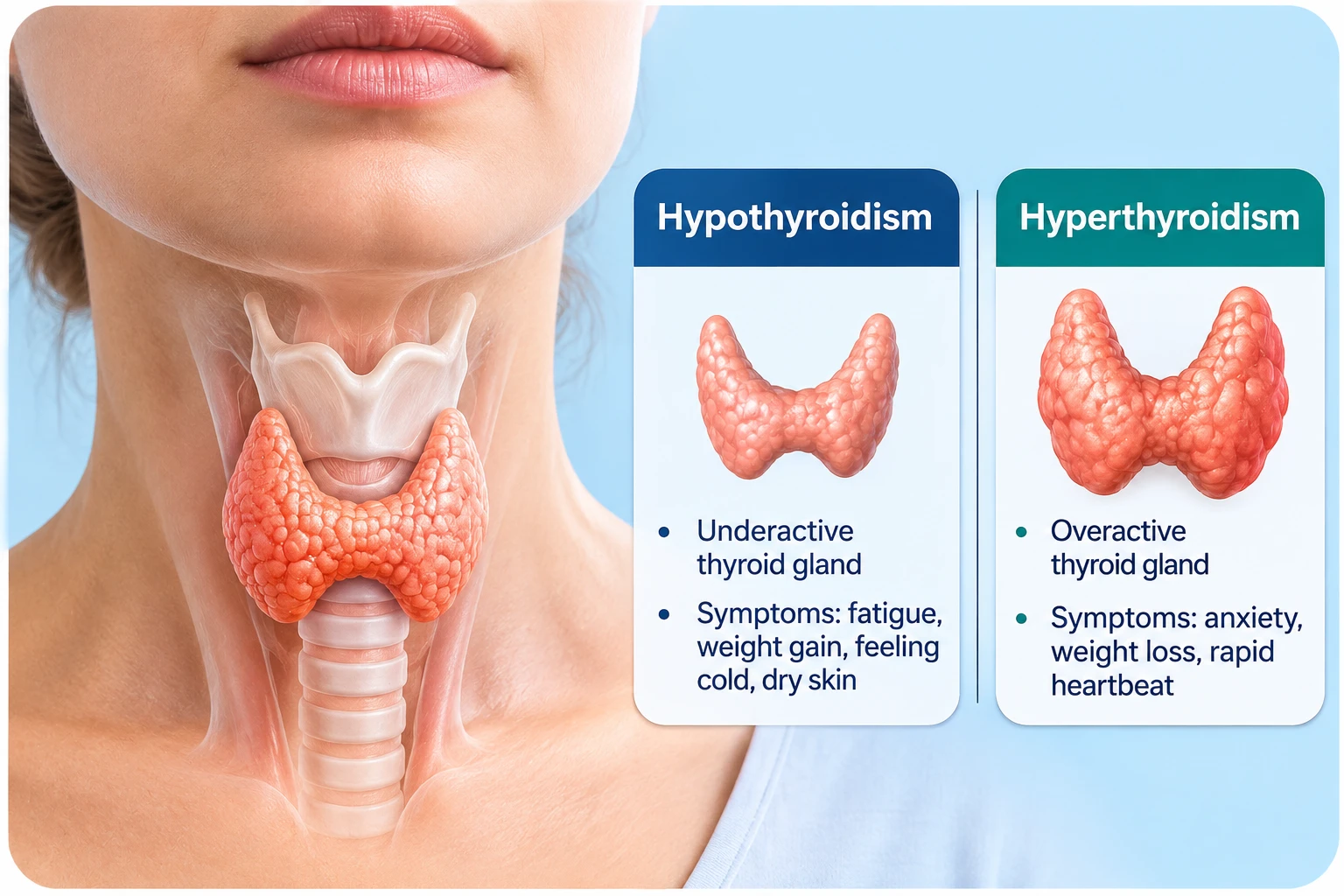
You might think there's something amiss if you feel tired after sleeping, don't have a normal appetite, or have an irregular heartbeat. One possibility is a thyroid problem, but there are other causes of the symptoms. Your visit to the Markland Wood Medical Clinic will include a discussion of your symptoms to determine the next course of action. The conversation is easier when you understand that the two conditions, hypothyroidism and hyperthyroidism, are quite different, but you don't have to self-diagnose yourself based on some list that you found on the internet.
What your thyroid actually does
The thyroid is a small, butterfly-shaped gland at the front of your neck. It makes hormones, primarily thyroxine (T4) and triiodothyronine (T3), which affect the body's use of energy. They influence the way the body regulates temperature, bowel movements, heart rate and so much more.
It is controlled by your brain using a hormone called thyroid-stimulating hormone or TSH for short. Imagine that TSH is a note to the thyroid gland to make it produce either more or less. In a normal functioning system, the levels of hormones remain in a normal range and do not continually oscillate between high and low levels.
Hypothyroidism is a lack of hormone. Hyperthyroidism is a condition in which the thyroid gland produces excessive amounts of. There are no symptoms that can be used to diagnose either of these conditions simply based on feeling tired, anxious or cold.
Hypothyroidism: when the system slows down
Low thyroid may make everyday activities seem more difficult. You may feel unusually cold, constipated, have dry skin, and/or trouble concentrating. Some weight gain, muscle weakness, fatigue and changes in hair colour may happen. Symptoms tend to progress slowly and are easily overlooked as being due to stress or old age.
One of the major causes is Hashimoto's disease. This autoimmune disease involves the immune system attacking the thyroid gland. Other causes of low levels of the hormone include previous surgery or radioactive iodine treatment. In less frequent cases, issues with the pituitary gland impact the signals used to regulate the manufacture of hormones.
An underactive thyroid isn't the same in all people. There are symptoms that are more obvious, while others discover them by testing. Weight changes are not a good indicator, and normal body weight does not exclude disease. The overall clinical picture is what is important.
Hyperthyroidism: when the system speeds up
Too much thyroid hormone can lead to rapid or irregular heartbeat, heat intolerance, sweating, shakiness, diarrhoea, and weight loss. Sometimes, individuals refer to their wired but exhausted feeling. It may be hard to sleep, and anxiety or irritability may seem strange or more intense.
Graves' disease is an autoimmune disease characterised by the body producing too much thyroid hormone. Some nodules may also secrete excessive amounts of hormone. Stored hormones may be released into the bloodstream by inflammation, thus causing the same excess-hormone state, but for a different reason.
Eye symptoms may occur in some people with Graves' disease, such as irritation, swelling or double vision. These do not only involve superficial issues. New visual alterations should be addressed promptly for medical attention. Hyperthyroidism is also not a healthy quick-fix for weight loss – if left untreated, it can impact the heart and other parts of the body.
Why symptoms do not tell the whole story
The idea of dividing symptoms into two columns, “low” and "high", is very appealing. Life is not as clean in real life. Both can result in fatigue, hair issues, muscular issues or not feeling like oneself. Hyperthyroidism does not always manifest as anxiety, and tiredness does not always indicate hypothyroidism.
Thyroid symptoms can be confused with anaemia, sleep disturbances, depression, effects of medicines, and other diseases. Your clinician might ask you about your periods, pregnancy history, family history, and any medications or supplements you take.
Your appointment will be more useful if you use a symptom diary. Note the onset of changes, actual weight change, palpitation and temperature intolerance. If possible, take old laboratory tests.
How thyroid testing works
A blood test for TSH is usually the first test performed, and if necessary, a test for free T4 is also conducted. With normal primary hypothyroidism, TSH is elevated, and free T4 is decreased. In normal hyperthyroidism, TSH will be reduced, and free T4 and/or free T3 will be elevated. There are exceptions, so there is a need for clinical interpretation.
Sometimes, an abnormal TSH level may be with a normal T4 level, this can be called as subclinical disease. The severity of the abnormality, symptoms, age of the patient, pregnancy plans, and other health risks affect the next steps, such as repeat testing.
Blood tests used to investigate autoimmune disease include antibodies. When a person has a lump or an enlarged gland, ultrasound may be helpful, but it is not always needed when all blood tests are abnormal. The primary care services in the clinic include assessment, chronic disease care, coordinated diagnostics and making speciality referrals as needed.
Thyroid treatment depends on the cause
Levothyroxine is a replacement thyroid hormone that's commonly used to treat hypothyroidism. Appropriate dosage can be determined by regular blood levels. The absorption can be influenced by food, supplements and other medicines, so stick to the instructions that have been given with your prescription and don't make up your own.
Drugs that decrease the amount of thyroid hormone, radioactive iodine, or surgery are used to treat hyperthyroidism. In certain patients, symptoms such as a racing heart may be controlled with an anti-racing drug called a beta blocker. The best option will depend on underlying factors, medical history, pregnancy and individual circumstances.
The treatments cannot be substituted. Excessive use of replacement hormones to boost energy levels can be a problem, and over-the-counter “thyroid support” medicines are not the same as diagnosis. To learn more, check out the guide to hypothyroidism on the Thyroid Foundation of Canada website.
Living with a thyroid diagnosis
Follow up appointments and communicate with your clinician if symptoms do not resolve with treatment. At times a repeat dose review is indicated; at other times there is an underlying medical condition that is causing the symptoms. Don't make the assumption that all new symptoms are from the same diagnosis.
Inform the care team of pregnancy or planning for pregnancy or if you have just given birth. Thyroid monitoring and treatment might need to be altered. Nutrition, activity level and rest are important to a person's overall wellness, and a healthy diet is not a cure all for prescribed treatment.
Book a thyroid assessment
Access online scheduling tools and check availability with the team.
Contact Markland Wood Medical Clinic at 416-695-8878.
The clinic is at 4335 Bloor Street West, Etobicoke, ON M9C 2A5.
Take your medication and supplement list, old test results and symptom notes. If the person complains of chest pain, becomes faint, has extreme difficulty breathing, or has a very fast heart rate and fever or confusion, the patient should not be booked for routine care; instead, they should be assessed immediately.
Learn more about general health tips on the clinic blog.
Frequently asked questions
1. What is the difference, or main difference, between these conditions?
Hypothyroidism is when there is not enough hormone; hyperthyroidism is when there is too much hormone. Symptoms overlap, and doctors use their history, physical exam, and blood tests to help identify them.
2. Is it possible to have a thyroid problem and feel fine but not gain or lose weight?
Yes. Weight is just one of the potential indicators. Stable weight does not exclude either condition if other symptoms or lab findings indicate an issue.
3. If a TSH is normal, is there a problem?
Many of the primary disorders are less likely if the result is normal. If symptoms persist, other causes should be considered and, in certain situations, further hormone testing should be undertaken.
4. A high TSH typically indicates what?
It's often a signal for the brain to tell the thyroid gland to do more. This is likely to be hypothyroidism if combined with the presence of free T4 and clinical conditions.
5. Is low TSH possible with normal T4?
Yes. This pattern must be interpreted and re-tested if necessary. The numbers should not be taken in isolation to make a diagnosis or treatment.
6. Is Hashimoto's disease equal to hypothyroidism?
No. Hashimoto's is an autoimmune disease which can lead to hypothyroidism. Antibodies may be present before there is enough hormone to be produced.
7. Can it be spread from one person to another?
No. Graves' disease is an autoimmune disorder, NOT an infectious disease that can be transmitted from person to person. It may involve continuous evaluation and management by a healthcare provider.
8. Is thyroid disease like anxiety?
Yes, especially when there is too much hormone present. However, other causes of anxiety exist, and symptoms should not be assumed to be related to either diagnosis.
9. Am I going to have to take medications all my life?
The symptoms of some causes may last a lifetime, while others may improve or go away. A diagnosis and follow-up result is more important than a 'rule of thumb'.
10. May I not take medicine when I am feeling better?
Avoid abrupt changes or discontinue treatment without advice. Feeling better doesn't necessarily mean that symptoms have gone away; it means treatment is effective.
11. Should I get all of the thyroid tests that are available?
Usually not. Most initial questions are addressed by TSH and some other tests. Larger panels do not necessarily provide more useful or appropriate information.
12. Should everyone have an ultrasound?
The blood tests are used to determine how an organ, like a lump, is working. Because imaging provides additional information that is useful, it is recommended if it is warranted by the examination and history.
13. Do problems occur following pregnancy?
Yes. Hormones levels may be affected by postpartum inflammation. Do not dismiss these as "new-parent stress," or simply go to bed at night and seek treatment the next morning.Don't dismiss these as "new-parent stress," and don't just go to bed at night and seek treatment the next morning.
14. Is there a particular type of food that helps a thyroid disorder?
No one diet will work to cure all these diseases. Do not take iodine or “support” supplements without a doctor's advice as this can be unneeded or detrimental.
15. At what time to ask for a specialist?
Referrals may be necessary if the results of the pregnancy are difficult to control, if the mother experiences eye symptoms, if there are nodules, or if there is a complex diagnosis. You can ask your primary care provider what applies to you.
This article is general health information and is not a substitute for advice from your doctor.